Today, my wife Becky and I paid a short visit to Myrtle Beach, South Carolina. Visitors to Myrtle Beach can’t help but notice the Palmettos planted around the city and other cities in the area. Here are some photos of a few of these trees. As far as I can determine, their scientific name is Sabal palmetto (Walt.) Lodd. (If this isn’t it, I would sure would like to know what it is.) There are forums on the internet which discuss the nativity of this in the Myrtle Beach area. They are definitely planted throughout the city, so I could see how they might not be considered to be native. Others state that they are native, and people have just planted them in areas where they were not naturally growing. Their native range is said to be in coastal areas from southeastern North Carolina to Florida and west along the Gulf Coast to Texas. Whatever is the case, it was fascinating to observe them. I was struck by the frond remnants found on many of them. They are called bootstraps. Some of the trees we observed had fruits still on them, and took some photos of them. We also noted a smaller species of Palmettos growing in the woods nearby. As far as I understand, they are probably Sabal minor or the dwarf palmetto. Wish I had more time to do some foraying.
Had an awesome time with Rangers Matt Grey and Chris Winton of Anne Arundel County Park and Recreation this afternoon scouting out the cactus at Weinberg Park in Pasadena. The site was near an old homestead. We could see two stone columns which could have come from a gate entrance. I understand that there is other evidence of a homestead at the site.
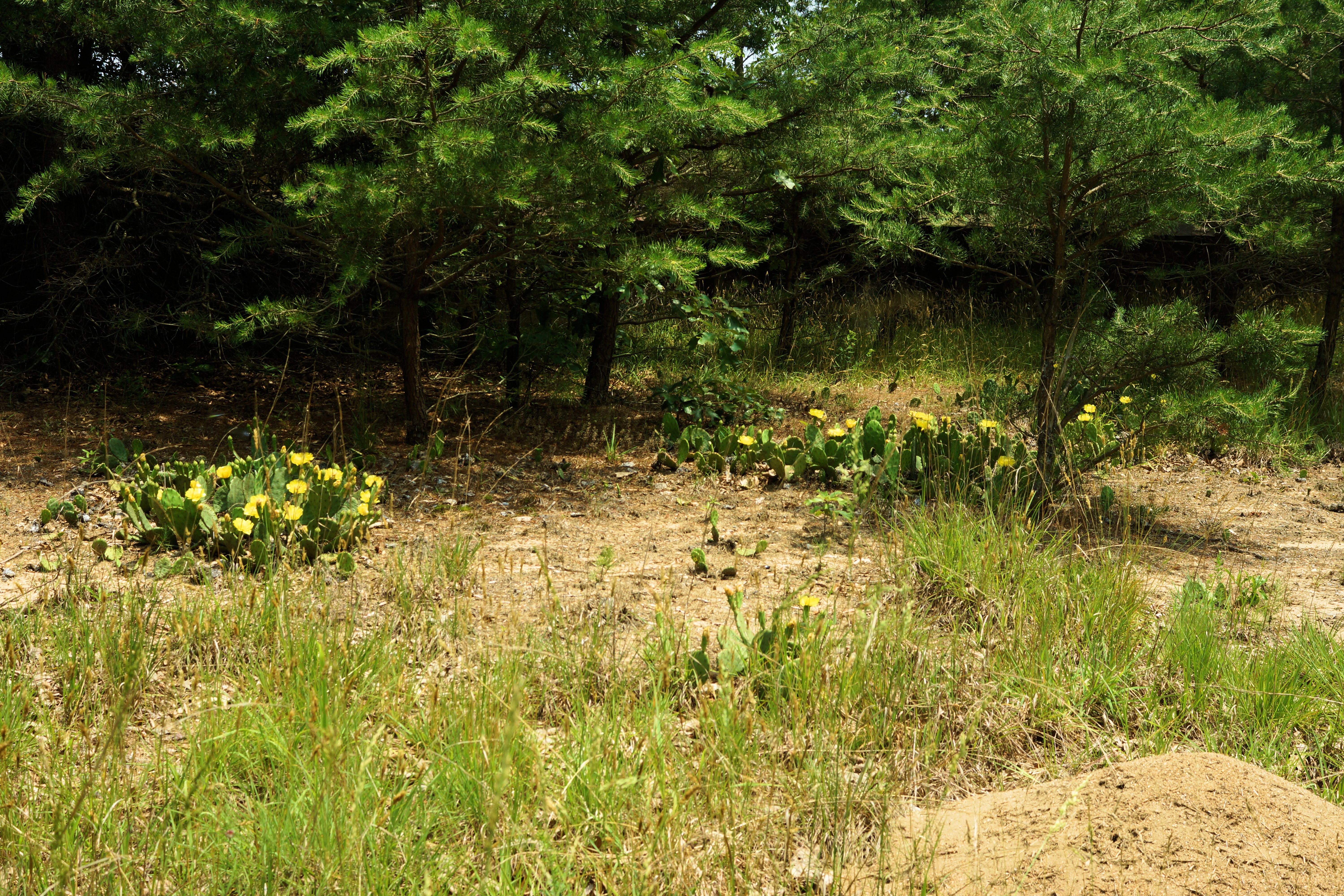
The site showed definite signs of anthropogenic disturbance likely from the folks who previously lived here. The soil was well-drained sand on a bluff above the bay. There is a high probability the cactus was planted and they were growing in an area about 15 feet by 15 feet. There were outlying scattered plants in the area as well.
Yucca flaccida growing nearbby
We also spotted some Yucca flaccida (weak-leaf yucca) which was planted nearby. This, when combined with the planting of cactus, suggests that someone wanted to create a desert-like appearance at this site.
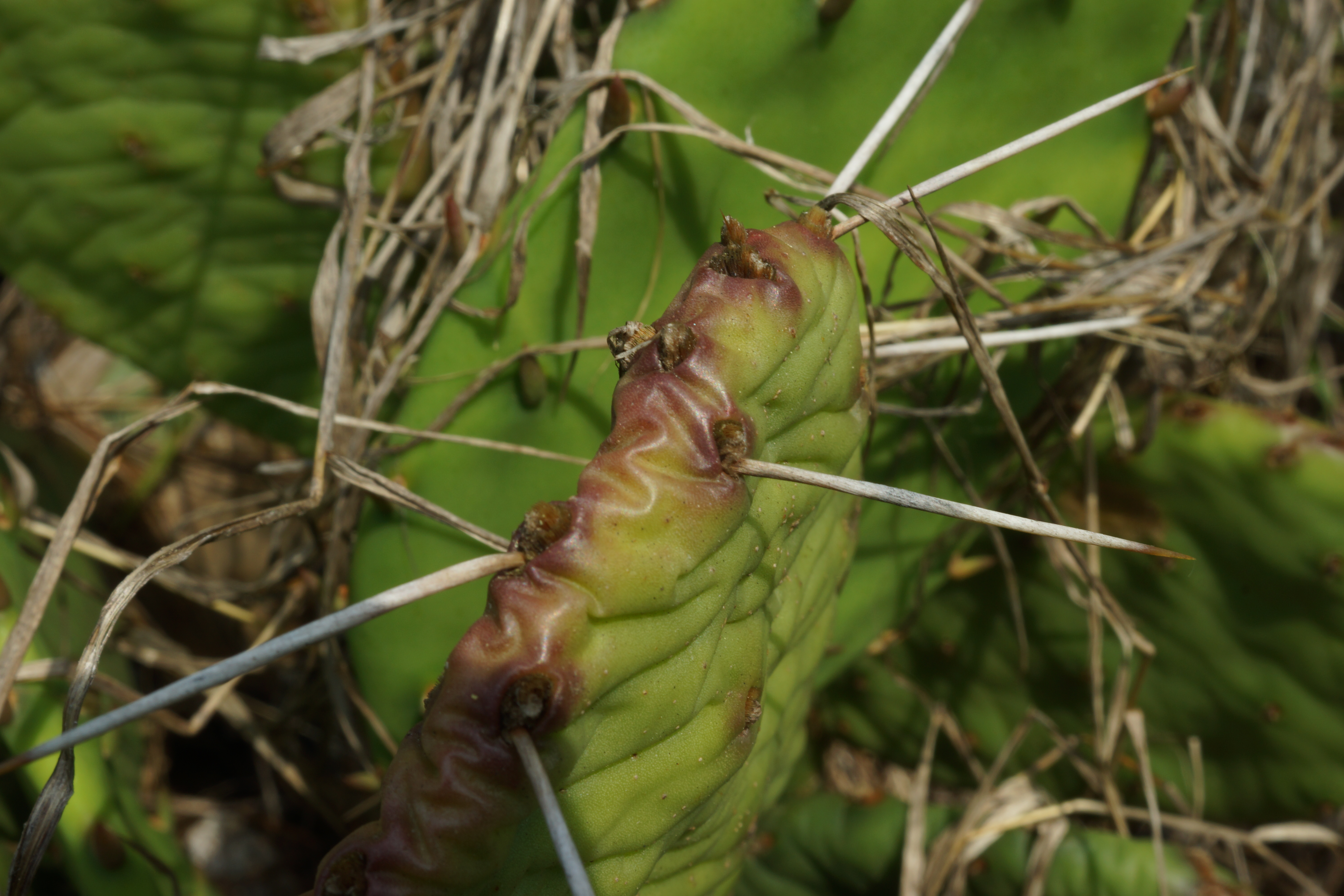
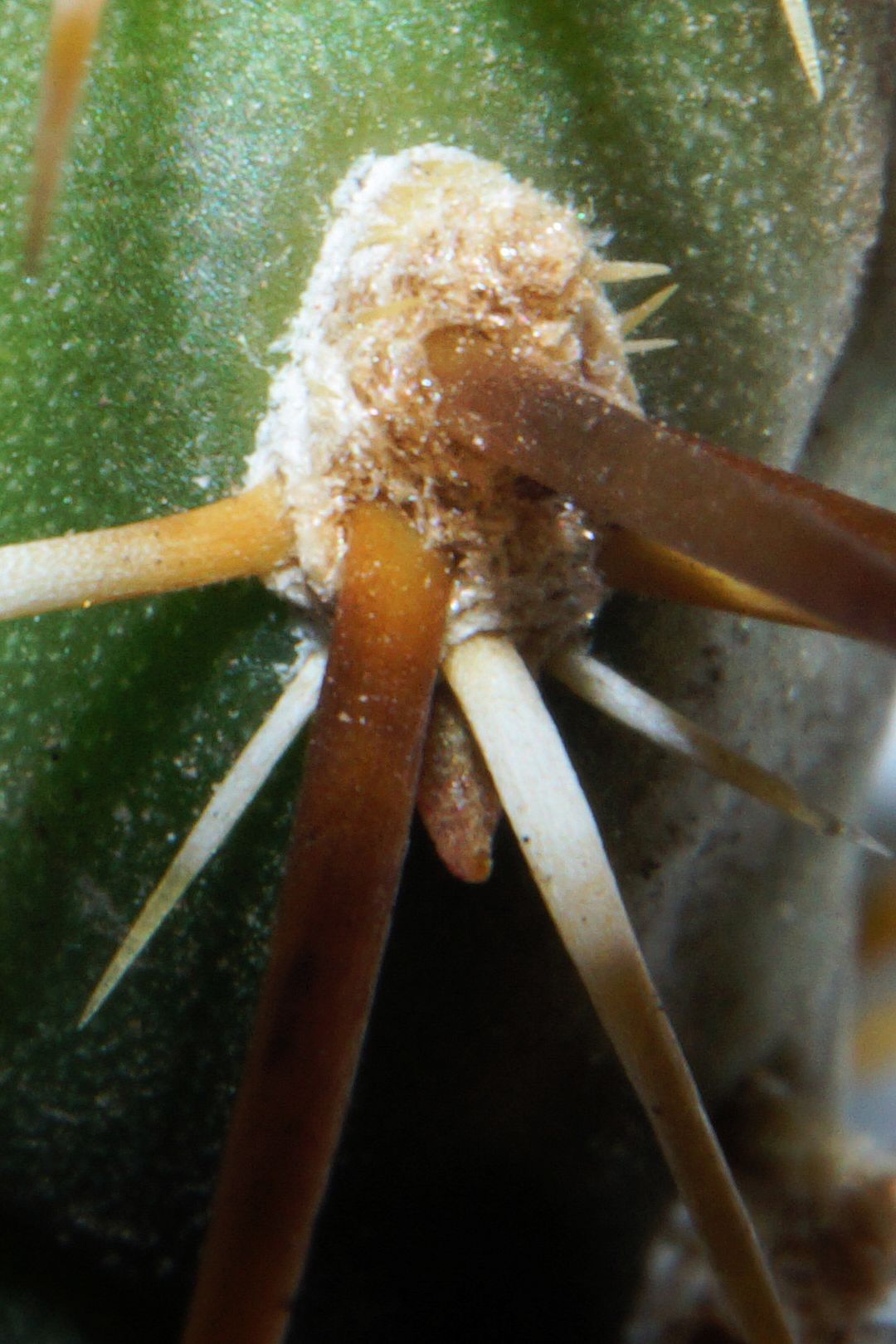
The morphology of the plants conform with a determination of Opuntia humifusa s.s. We did not find spines on any of the plants and there were mostly 4 to 5 (6) areoles per diagonal row on the cladodes. The seeds were 4.0 to 4.8 mm long.
We plan to re-visit the site in the spring to note the flower coloration.
This is a working draft list of locations where cactus has been found in Maryland, excluding the Eastern Shore. (Eastern Shore sites may be added later.) If you know of a location not listed here, let me know at botanybill (at) verizon.net and I will put it on the list. Also if you would like to claim a site to watch, let me know.
Alleghany County
Cumberland – near exit 43 on I-68.
Flintstone – (at least three stations) – Opuntia humifusa s.s.
Anne Arundel County
Arundel High School and Arundel Middle School – possibly mowed over –
Global Command Antenna Field, Davidsonville – Jo Mercer
Hancock’s Resolution – Field north of house – Not found – Extirpated
Hancock’s Resolution – Planted in garden – Opuntia cespitosa – Chris WInton and Matt Grey
Jug Bay, Parking Lot Meadow – Bill Harms
Jug Bay, Sand Barrens, Parris Glendenning Area (Wayson’s Corner?) – Bill Harms (More info)
Jug Bay, South Farm
Milt’s Sand Pit, Sands Road – large population – old field – Opuntia humifusa – Bill Harms – (More info)
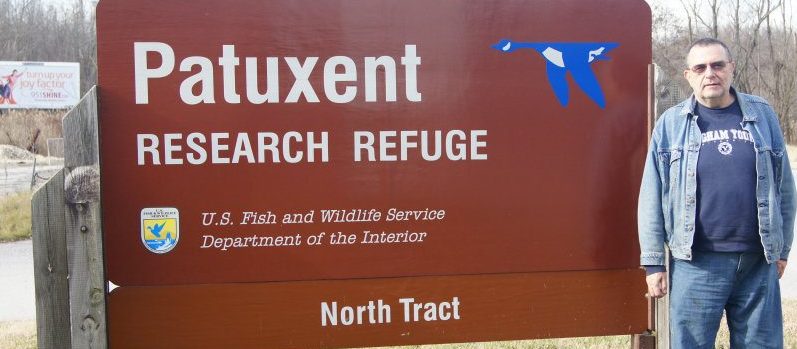
Patuxent Research Refuge, Lake Allen – large population – Opuntia cespitosa with some putative introgression with Opuntia humifusa – Bill Harms (More info)
Patuxent Research Refuge, East of Tipton Field – likely planted many years ago – >Opuntia cespitosa – with some putative introgression with Opuntia humifusa – Bill Harms
Sandy Point State Park – Extirpated?
Weinberg Park – Opuntia humifusa s.s. – probably planted
Wooton’s Landing – assumed to be planted in two stations. Not found June 2019 – Possibly removed.
Despite some rain, heavy at times, had a awesome time today meeting up with Joe Metzger and Karyn Molines to foray the Parris Glendening Nature Preserve, Jug Bay. We hiked about one mile to an area called the “Sand Barrens” to look for some prickly pear cactus. It was an open clearing with sandy soil in the middle of pine-oak-maple woods.
The cactus is definitely in the Opuntia humifusa complex, but determining which species was problematic. These plants were spineless and had three to four areoles per diagonal row at the widest part of the cladodes. So, this could be Opuntia humifusa s.s. with three or four areoles per row, or Opuntia mesacantha with no spines. Or it could be something else… Further investigation is needed.
To get a clue about which species this could be, it would be useful to examine two historical collections of cacti in Wayson’s Corner area. The Parris Glendening Nature Preserve is in the general Wayson’s Corner area. As the Nature Preserve was not in existence when these two vouchers were collected, it is possible that these vouchers may have collected on what is now the Nature Reserve. Unfortunately, the exact locations where these vouchers were collected are unknown, so it is also possible that they may have been collected somewhere outside of what is now the Nature Preserve. Regardless, the vouchers could be from the same basic genetic stock.
In 1950, L. B. Smith collected a voucher specimen in Wayson’s Corners, which he determined to be Opuntia humifusa. Click here to see the voucher. (NOTE: There are no visible spines on this specimen.)
In 1969, Clyde Reed collected a specimen in Wayson’s Corner, which he determined to be Opuntia humifusa. Lucas Majure later determined that specimen to be Opuntia mesacantha. Click here to see this voucher specimen. (NOTE: robust spines, which are indicative of O. mesacantha in available keys, are not present on this specimen. However, a few short barbs which are larger than the glochids or bristles are visible on close examination.)
On the way back to our cars, we found a patch of Centrosema virginianum – Spurred Butterfly Pea, a Maryland State S2 plant (threatened species).
Last time we attempted to identify a Forget-Me-Not that was found growing in Oldtown Elkridge. (Click here to see the first part of the story.)
After looking at the key, we narrowed the possibilities down to three species – Myosotis arvensis, Myosotis discolor, and Myosotis stricta, the last three species on the key.
So today I went out to the station where we first found the plant. Of course, the flowering stems had elongated and there were more fruits. The fruiting pedicels were all shorter than the calyces. The plants were floriferous (with flowers) well below the middle of the flowering stems. I did not see any styles extending beyond the mericarps. After running this through the key in the first blog entry, we come up with Myosotis stricta Link ex Roem. & Schult. or Strict Forget-me-not.
CONCLUSION: sometimes you have to look at a plant at different stages to be sure of an identification.
Old Erie Canal (Clinton’s Ditch) on left and the “New” Erie Canal on the right
This time we diverge from looking at plants. On our hike on the Butterfly Trail at Lock # 30, Erie Canal, Macedon, New York, we found at least four mollusks. In the first picture, you can see the “beach” where we found them. It was mostly made up of the remains of shells. We would like to know what are the exact species. If you know or can verify the exact species of these mollusks please let us know.
Zebra Mussels (Dreissena polymorpha)
The first shells that we are looking at are Zebra Mussels (Dreissena polymorpha). They are an aggressive invasive species throughout a large portion of North America. They were first detected inNorth America in the Detroit-Windsor area in 1988. They are considered a serious pest.
Asian Clam (Corbicula fluminea)
This one is believed to be the bivalve mollusk called the Asian Clam (Corbicula fluminea).
I have no idea what this is. For this article I am calling it a Striped Snail. This little guy was alive when we found it.
I am calling this one a Cone Snail. They are similar to some snails that we used raised in aquariums when I was younger.
Let’s have some fun here. This time, we will focus on the difficulty in identifying the species of plants. I found a large patch of plants next to a parking area in “Oldtown” Elkridge. It was obvious to me that they were forget-me-nots (Myosotis sp.) But I was not sure of which species it was.
So, what shall we do to figure out what species this is? For this we will consult the Myosotis key in Alan Weakley’s Flora of the Southern and Mid-Atlantic States, 2015. There are other keys avaialble, but for the purpose of this article, we will stick with this one. (See bottom of the page of the excerpt of the key).
The first choice in the key deals with the pubescence on the calyx:
1 Calyx strigose, the hairs neither spreading nor uncinate.
-OR-
1 Calyx with some loose or spreading, uncinate hairs.
Okay, strigose means short and appressed, the hairs of which on our Myosotis are not. Furthermore, at least some of the calyx hairs seem to be uncinate, meaning they are like hooks. So we will go with the second one in the pair.
The next choice is as follows:
3 Corolla limb 5-8 mm wide; perennial
– OR –
3 Corolla limb 1-4 mm wide; annual or biennial.
Our plants are not perennial and the corolla limb was measured to be less than than 5 mm. So the second one of this pair fits better.
Going down the key, this is the next choice:
4 Calyx lobes unequal, 3 lobes shorter than the other 2; corolla white; [native, of dry or moist habitats].
– OR –
4 Calyx lobes equal, all 5 the same size; corolla blue (occasionally yellow or white); [alien, mostly of dry disturbed habitats].
Right off, the corolla lobes are equal and the same size, the corolla is blue, and the habitat is disturbed. So we have to go with the second one of the pair.
Here is the next choice.
6 Fruiting pedicels equaling or generally longer than the calyx
– OR –
6 Fruiting pedicels distinctly shorter than the calyx.
Okay, this is a bit problematic. That is because the plants are in an early stage of blooming and there are not many fruiting pedicels to look at. The ones that are visible seem to be shorter than that the calyces, but the pedicels could end up being longer than the calyces as the plants mature. Identifying the plants at this point would be not much more than a guess. (There are three possibilities based on this key – Myosotis arvensis, Myosotis discolor, and Myosotis stricta.)
So for now, let’s wait for a week or two and go back to this location to see if the pedicels will be longer. (They are not going anywhere.) Then we can look at the key again. There are three possible species left in the key, and after we figure out if the pedicels stay shorter than the calyces or not, we will be able to be more confident about determining which species this is.
(Continued in Part 2)
The key for Myosotis from Weakley’s Flora of the Southern and Mid-Atlantic States, 2015.
On the way home from work today, I took a bunch of pictures of two established colonies of Aesculus parviflora (Bottlebrush Buckeye) near our home. One of them was in the middle of someone’s lawn and the other one was in the woods. I first spotted them six years ago, and they have spread since then. The latter one ran for about 100 feet along the road and was about 50 feet back into the woods. Three or four saplings had popped up across the road from this colony. I am not sure if they are primarily spread from seedlings or if they are clones, but they sure like where they are at.
The following are photographs that I took today. (Click on the thumbnails for a larger view.)
The following are photographs that I took in previous years.
About 15 years ago, I spotted two colonies of white roses across the street from our house. They were not the Multiflora Rose (Rosa multiflora) which had already mostly finished because blooming, and this rose was in its prime.
It keys it out to Memorial Rose (Rosa wichuraiana) Crép. It is native to East Asia, and has a natural sprawling, but not climbing, habit which makes it attractive as a ground cover. These two colonies could be considered persistent/established and spreading.
These are some photos I took of this simple but elegant flower. There are some cultivar forms of this species including one with pink tinged petals and a double petal form.
In the fall, it produces small red hips. It is named after the German botanist Max Ernst Wichura. Its scientific name is synonymous with Rosaluciae Franch. & Rochebr., which is sometimes seen in literature.
This afternoon, I took a quick jaunt out to Lake Allen to take some pictures of the Eastern Prickly Pear, a type of cactus that is found on the Refuge. Its scientific name is Opuntia cespitosa Raf. Its natural range is primarily west of the Appalachians and east of the Mississippi. However, there are scattered populations of this species along the Atlantic Seaboard from New England to Georgia.
The population on the refuge is rather large, covering several acres. It could be one of the largest populations of cactus in Maryland. On the refuge, it thrives in the sandy soils of the northeastern part of the North Tract by Lake Allen and by the firing ranges.
Allegheny Mound Ant mound in the upper left hand corner
It is shade intolerant and thrives in full sun, and needs well-drained soil.
The fruit of the Opuntia cespitosa is edible, and can stay on the plant until the next spring. Here on the refuge, it blooms from late May to mid-June.
In a couple of the shots I had to deal with the pesky Allegheny Mound Ants (Formica exsectoides). Without looking, I plopped down on a swarm of them, and within a minute or so they were crawling all over me. I even had to take one off of my forehead. They are an interesting critter and merit a separate blog entry. You can see a couple of their mounds in the pictures on this page. (More about them in future blog entry)
This morning a common snapping turtle was trying to cross the road in front of our house. I believe this was a female in search of a nesting site, and could be the same one we saw on our driveway several years. She was first spotted by my wife Becky and after she alerted me, I went out to see what was going on. I managed to take a few photos and then I moved her off the road so she would not get hit. To avoid getting bit and getting clawed by their legs, it is best to grab them in a place where they cannot reach, like by the carapace (upper shell) above their hind legs. She did not like my picking her up at all. But I safely moved her out of harm’s way without incident.
The common snapping turtle‘s scientific name is Chelydra serpentina L. They are native to much of the USA except the extreme Far West. They are also found in the southern part of Canada as far west as Alberta. They are omnivores and will scavenge for animal and plant matter; they are also active hunters and will eat any animal they can fit in their mouths. Their life span is not well known, but is assumed to be at least 100 years.
They have a ferocious disposition and as a result make poor pets. Their name suggests that they have a strong bite. While it is true one would not want to get bit by one, their strength of their bite is comparable to a human.
They have become invasive in some parts of Europe probably because of people releasing them after trying to keep them as pets.
Swamp doghobble (Eubotrys racemosa (L.) Nutt.) is a member of the Ericaceae (Heath Family) and is native in the USA along the Coastal Plain from Massachusetts to Florida to Texas. It lives in various habitats such as savannas, forests, and bogs. It is not shade tolerant. The leaves are deciduous. The inflorescence is a row of bell-shaped white flowers each just under a centimeter long. The fruit is a capsule.
The scientific name for this species in some references is Leucothoe racemosa L. Other common names for the swamp doghobble include fetter-bush, leucothoe, sweet-bells leucothe, and sweetbells.
On the refuge, you can find swamp doghobble in open boggy areas. I found the specimen seen here in the BGE Powerline Right-of-way on the North Tract.
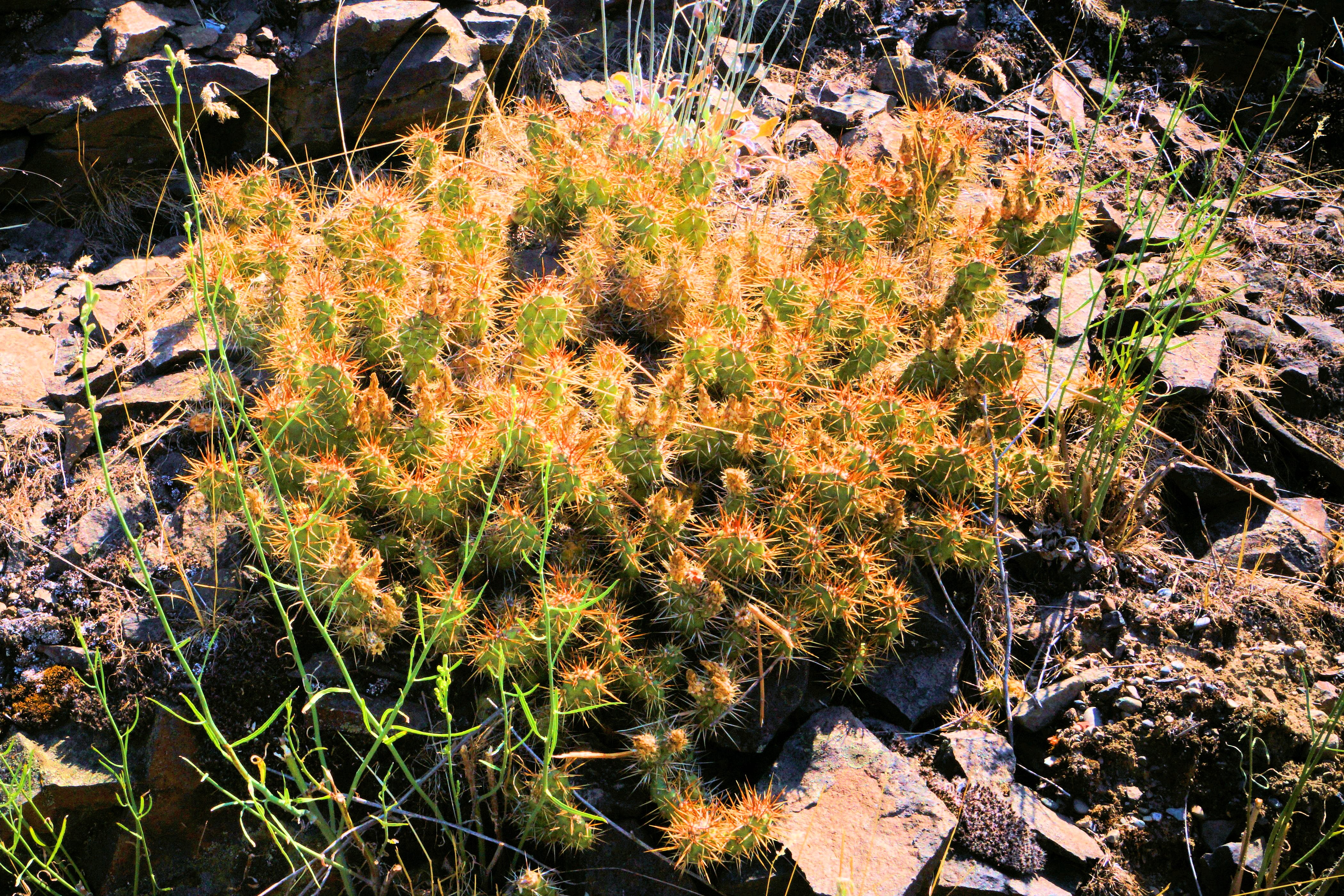
Today while driving out of town (Spokane) I spotted something that looked out of place off to the left. It was several clumps of orangish colored vegetation on a basalt rock outcropping. No way! It looked like it could be cactus. But cactus is not supposed to be wild in Spokane… Okay, I parked the car and walked up to the site. This can’t be true! I about fell over, it was indeed cactus! (Click on the thumbnails for larger view. May take a few moments to load.)
At first I thought it was Opuntia fragilis (Brittle Prickly Pear) because the pads easily detached when I handled the plants. However, things did not look quite right. The pads were flatter than I remembered. Additionally the spines were a little longer and were brownish-orange especially near the end. So I just chocked it up to a different form or variety of Opuntia fragilis.
Another possibility was Opuntia polyacantha (Plains Prickly Pear), but this plant did not look quite like the ones of this species I had seen before. The pads were smaller on the average and the spines were different from what I remembered. I wanted to be sure, but unfortunately I was on vacation and I did not have my plant references and keys with me.
Another thing that bothered me was that as far as I knew there were no reports of wild cactus growing in Spokane County. So, this was something else I had to check out.
Well, I collected a few pads for specimens and headed off to Seattle.
After arriving in Seattle and getting settled in, I connected to the Internet and sent off emails to people in Washington State that I thought may be able to answer my questions. Sure enough, Dick Olmstead and David Giblin of the University of Washington Herbarium quickly replied. Between them I learned that sure enough, the Pacific Northwest Herbaria Database did not list a record of cactus for Spokane County. However, Dick informed me that he had seen some cactus growing on a basalt outcropping behind a motel on the west side of Spokane. I also looked at the National Herbarium’s online database, and learned that they have a specimen for Opuntia fragilis that was collected by V.O. Bailey in Spokane in 1907. It was listed as cultivated and did not state the exact location. David and Dick informed me that my find could be Opuntia Xcolumbiana (Grizzly Bear Prickly Pear).
According to Benny Møller Jensen, this hybrid between Opuntia fragilis and Opuntia polyacantha produces seeds but they are difficult to germinate.
This particular cactus, although limited in distribution, is well known in the Columbia River and Snake River Valleys in Southeastern Western and adjacent Idaho and Oregon. There are a few outlying populations in Northern Washington and adjacent British Columbia. Its morphology is said to be fairly variable. This population in Spokane County falls within a reasonable range although it is some distance from the Snake and Columbia Rivers. I recall seeing a population of Opuntia near the confluence of the Spokane River and the Columbia River many years ago, but don’t know that this is the same cactus.
So, I have some things to check out.
With my specimens in hand, I will press them and send them off to Washington State herbaria to document my sighting. If I have some pads left over I will try to see if I can get it to grow.
Since this is a singular sighting of cactus in Spokane, I will keep this location a secret for now.
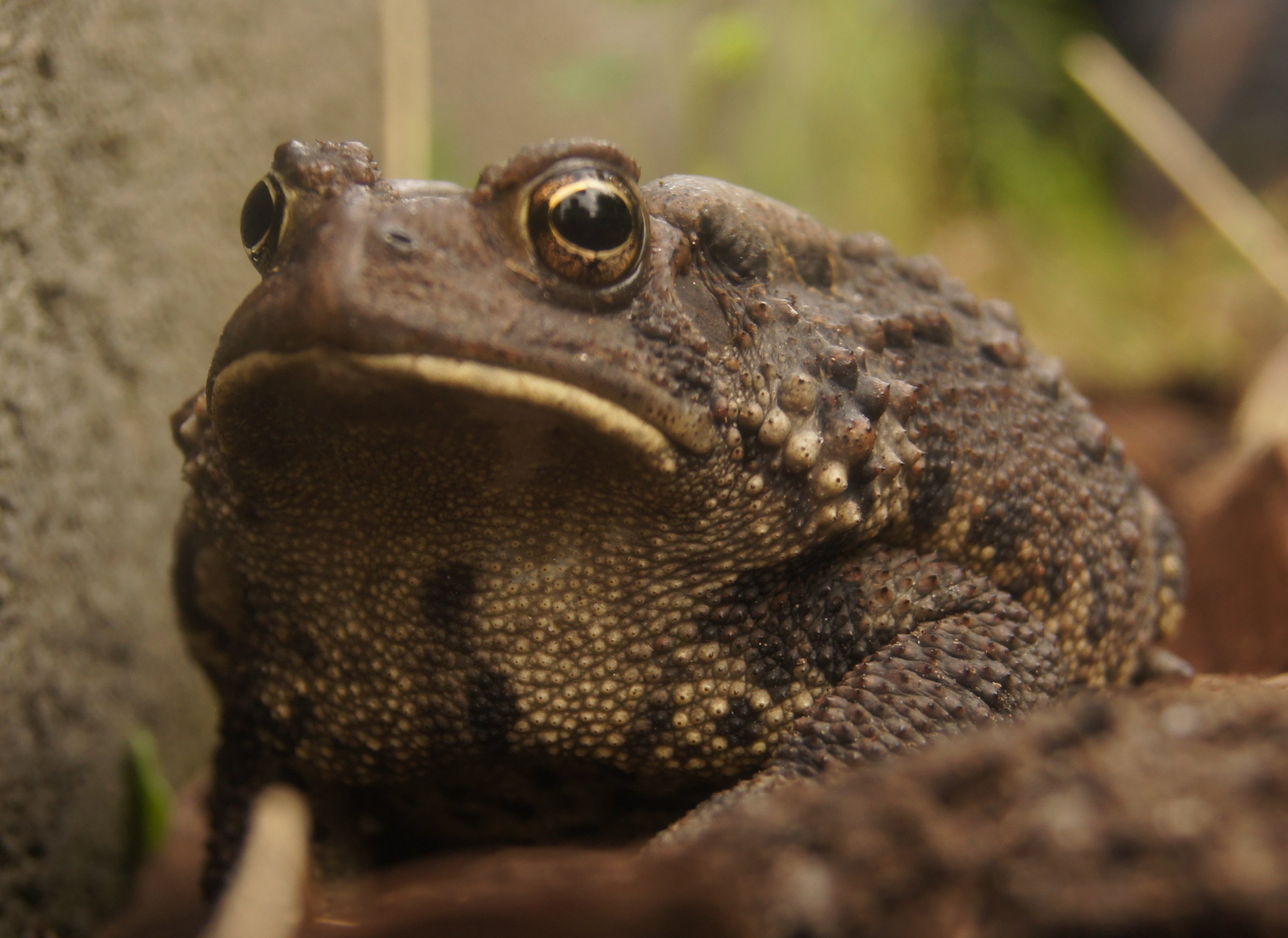
While weeding our garden, my wife Becky spotted a welcome friend, an Eastern American Toad (Bufo americanus americanus). Eastern American Toads are frequently found around human habitations throughout the eastern part of North America. They serve a good purpose because of their appetite for insects.
Interestingly, they do not croak like frogs. Instead they trill. Our friend is likely a female so she is silent. Females are generally larger than the males and have a lighter, more evenly colored throat.
(Check out the photos below. You can click on the photos for an enlarged view.)
I drove out to Lake Allen to see what was going on and noticed a large bird flying over the water looking for something. It had its legs and talons extended. Upon closer examination, it was an osprey. I grabbed my camera to see if I could get a good shot. By the time I got it ready, the osprey was flying high. I managed to get a half-way decent shot of its under plumage – good enough for identification anyway.
Ospreys are not unusual sights on the refuge, but they usually don’t stick around. There are at least four sub-species found throughout the world. The sub-species typically found in most of North America is Pandion haliaetus carolinensis (Gmelin, 1788).
The Giant White Wakerobin (Trillium albidum J.D. Freeman) is member of the Melanthiaceae (Bunchflower Family) that is endemic to a limited area of Washington, Oregon, and Northern California. It is found in mixed wood and coniferous forests at elevations up to 6,000 feet.
The plants occur singly or in large clumps and are between 8 and 28 inches tall. The stems are bare except for three 5 to 6-inch long leaves near the top, and are green with some light mottling in brown. A single flower grows on the top of the stem. The petals are a creamish white in color and are 2 to 4 inches long. The green sepals are 1 to 3 inches long.
These photos were taken at the Bellevue Botanical Garden in Bellevue, Washington.
One of the most fascinating things about the Bellevue Botanical Garden were the Licorice Ferns (Polypodium glycyrrhiza D.C. Eaton) growing on trees. It seems to prefer the Bigleaf Maple, like the ones I took pictures of here. It is an evergreen fern that is endemic to Western North America from Alaska and the Yukon on the North to California on the South. There are two highly disjunct populations in Idaho and Arizona. It thrives in cool humid climates and is commonly found growing among moss on the ground, on logs, and on rocks in addition to trees.
It is called Licorice Fern because of its licorice-flavored rhizomes which were chewed by Native Americans. It is said to have medicinal value as a treatment for colds and sore throats.
The Licorice Fern is in cultivation with at least one award winning variety. It is easier to grow than most ferns because it is not rock dependent.
The Trillium-leaved Woodsorrel (Oxalis trilliifolia Hook.) is one of three endemic woodsorrels found in the Pacific Northwest. It naturally occurs west of the Cascade Crest in Washington, Oregon, and California. There are a few outlying populations in Eastern Oregon.
It is an early summer blooming perennial that typically grows to 5 to 10 inches in height.
The five-petaled white to pinkish flowers are streaked with reddish veins. The flowers are 0.5 inch long. The plants can form verdant dense carpets in dense conifer forests. The 1.5 inch long leaves are typical of woodsorrels with three leaflets borne on the end of 2 to 8 inch long petioles. Each leaflet are heart-shaped with a fold in the middle.
It can make a fine ground cover with enough moisture.
I have not seen a chain gutter downspout before. I thought this one at the Tateuchi Viewing Pavilion in the Bellevue Botanical Garden was cool-looking. A couple of the pictures turned out okay, but the doggone camera thought it was going to be smart and it focused on the background. So the pictures are fuzzy. Next time I will use manual focus. Sigh…. I like the idea of making this type of downspout anyway.
By the way, you can see some Western Red Cedar (Thujaplicata Donn ex D. Don) in the background. I can’t resist pointing them out.
 Today, my wife Becky and I paid a short visit to Myrtle Beach, South Carolina. Visitors to Myrtle Beach can’t help but notice the Palmettos planted around the city and other cities in the area. Here are some photos of a few of these trees. As far as I can determine, their scientific name is Sabal palmetto (Walt.) Lodd. (If this isn’t it, I would sure would like to know what it is.) There are forums on the internet which discuss the nativity of this in the Myrtle Beach area. They are definitely planted throughout the city, so I could see how they might not be considered to be native. Others state that they are native, and people have just planted them in areas where they were not naturally growing. Their native range is said to be in coastal areas from southeastern North Carolina to Florida and west along the Gulf Coast to Texas. Whatever is the case, it was fascinating to observe them. I was struck by the frond remnants found on many of them. They are called bootstraps. Some of the trees we observed had fruits still on them, and took some photos of them. We also noted a smaller species of Palmettos growing in the woods nearby. As far as I understand, they are probably Sabal minor or the dwarf palmetto. Wish I had more time to do some foraying.