
Category Archives: Trip to Spokane

6 August 2014 – Wild Cactus Discovered in Spokane County

Dried flowers and fruit

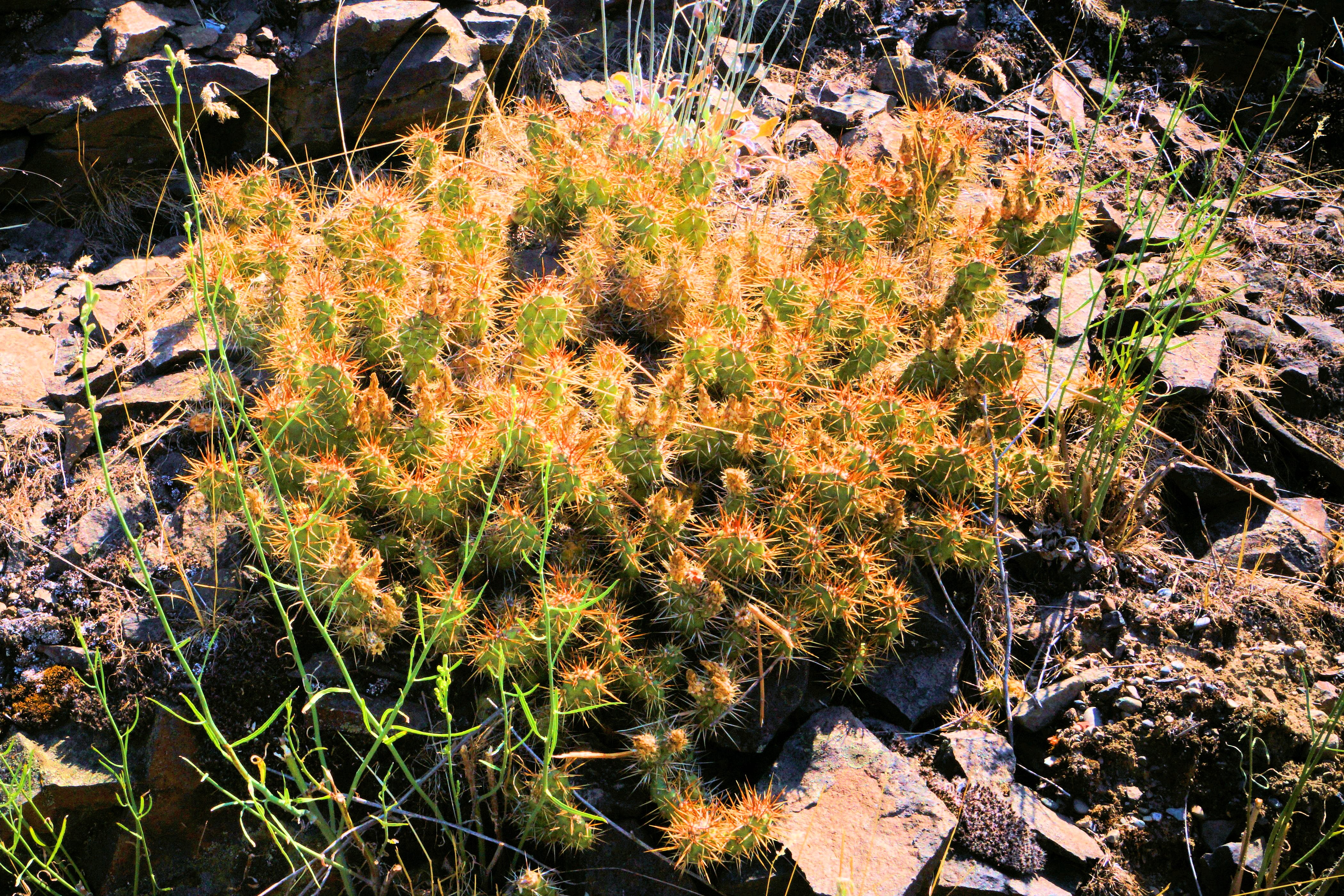
Today while driving out of town (Spokane) I spotted something that looked out of place off to the left. It was several clumps of orangish colored vegetation on a basalt rock outcropping. No way! It looked like it could be cactus. But cactus is not supposed to be wild in Spokane… Okay, I parked the car and walked up to the site. This can’t be true! I about fell over, it was indeed cactus! (Click on the thumbnails for larger view. May take a few moments to load.)

DSC00387

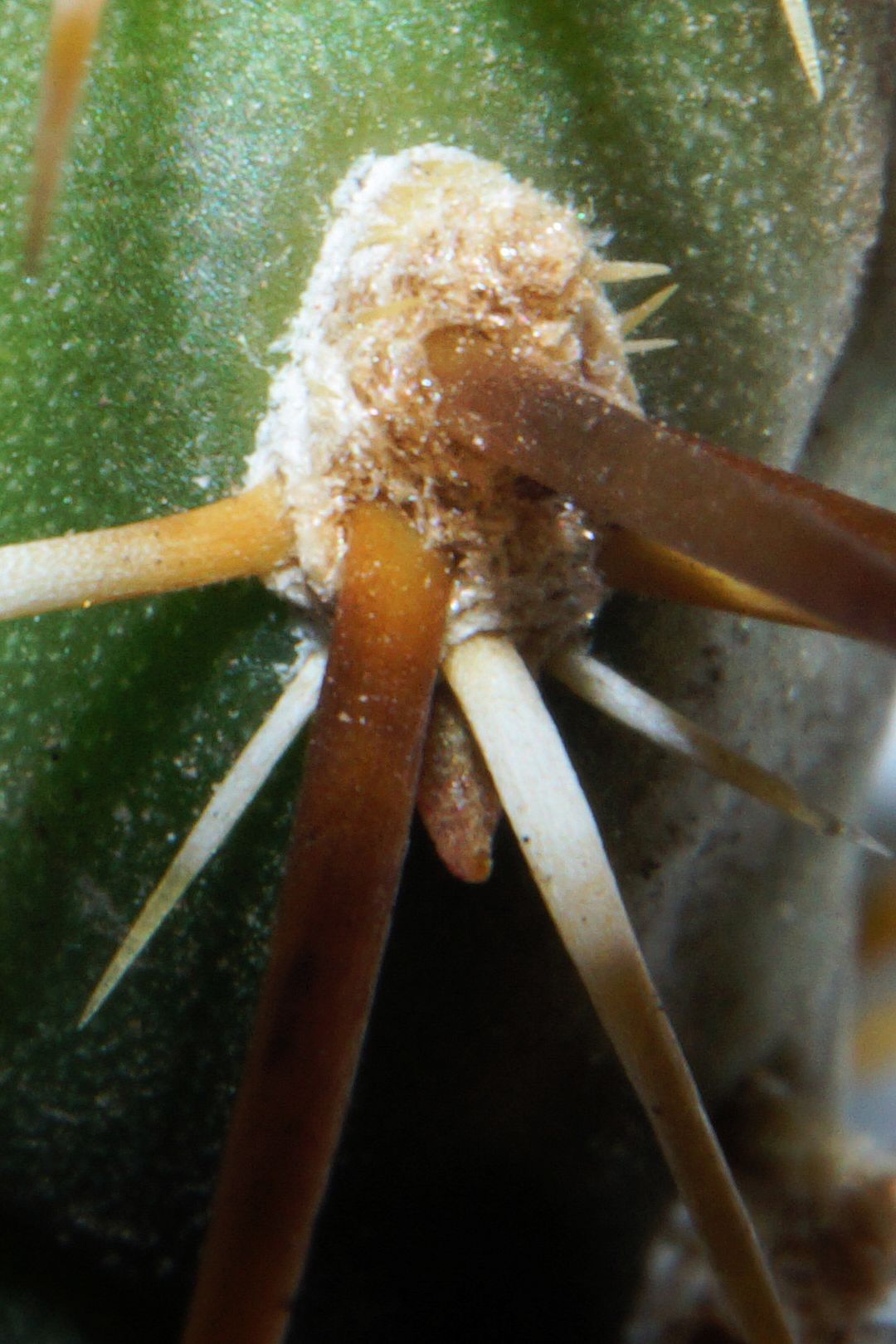
At first I thought it was Opuntia fragilis (Brittle Prickly Pear) because the pads easily detached when I handled the plants. However, things did not look quite right. The pads were flatter than I remembered. Additionally the spines were a little longer and were brownish-orange especially near the end. So I just chocked it up to a different form or variety of Opuntia fragilis.

DSC00389

Another possibility was Opuntia polyacantha (Plains Prickly Pear), but this plant did not look quite like the ones of this species I had seen before. The pads were smaller on the average and the spines were different from what I remembered. I wanted to be sure, but unfortunately I was on vacation and I did not have my plant references and keys with me.

DSC00431

Another thing that bothered me was that as far as I knew there were no reports of wild cactus growing in Spokane County. So, this was something else I had to check out.

Well, I collected a few pads for specimens and headed off to Seattle.
DSC00388

After arriving in Seattle and getting settled in, I connected to the Internet and sent off emails to people in Washington State that I thought may be able to answer my questions. Sure enough, Dick Olmstead and David Giblin of the University of Washington Herbarium quickly replied. Between them I learned that sure enough, the Pacific Northwest Herbaria Database did not list a record of cactus for Spokane County. However, Dick informed me that he had seen some cactus growing on a basalt outcropping behind a motel on the west side of Spokane. I also looked at the National Herbarium’s online database, and learned that they have a specimen for Opuntia fragilis that was collected by V.O. Bailey in Spokane in 1907. It was listed as cultivated and did not state the exact location. David and Dick informed me that my find could be Opuntia Xcolumbiana (Grizzly Bear Prickly Pear).

DSC00441

According to Benny Møller Jensen, this hybrid between Opuntia fragilis and Opuntia polyacantha produces seeds but they are difficult to germinate.

DSC00427 a

This particular cactus, although limited in distribution, is well known in the Columbia River and Snake River Valleys in Southeastern Western and adjacent Idaho and Oregon. There are a few outlying populations in Northern Washington and adjacent British Columbia. Its morphology is said to be fairly variable. This population in Spokane County falls within a reasonable range although it is some distance from the Snake and Columbia Rivers. I recall seeing a population of Opuntia near the confluence of the Spokane River and the Columbia River many years ago, but don’t know that this is the same cactus.

DSC00385

So, I have some things to check out.

With my specimens in hand, I will press them and send them off to Washington State herbaria to document my sighting. If I have some pads left over I will try to see if I can get it to grow.
DSC00441 a

Since this is a singular sighting of cactus in Spokane, I will keep this location a secret for now.

6 April 2013 – Giant White Wakerobin

The Giant White Wakerobin (Trillium albidum J.D. Freeman) is member of the Melanthiaceae (Bunchflower Family) that is endemic to a limited area of Washington, Oregon, and Northern California. It is found in mixed wood and coniferous forests at elevations up to 6,000 feet.


The plants occur singly or in large clumps and are between 8 and 28 inches tall. The stems are bare except for three 5 to 6-inch long leaves near the top, and are green with some light mottling in brown. A single flower grows on the top of the stem. The petals are a creamish white in color and are 2 to 4 inches long. The green sepals are 1 to 3 inches long.

These photos were taken at the Bellevue Botanical Garden in Bellevue, Washington.

6 April 2013 – Licorice Fern Growing on Moss-covered Bigleaf Maples

SONY DSCOne of the most fascinating things about the Bellevue Botanical Garden were the Licorice Ferns (Polypodium glycyrrhiza D.C. Eaton) growing on trees. It seems to prefer the Bigleaf Maple, like the ones I took pictures of here. It is an evergreen fern that is endemic to Western North America from Alaska and the Yukon on the North to California on the South. There are two highly disjunct populations in Idaho and Arizona. It thrives in cool humid climates and is commonly found growing among moss on the ground, on logs, and on rocks in  addition to trees.

SONY DSC


It is called Licorice Fern because of its licorice-flavored rhizomes which were chewed by Native Americans.  It is said to have medicinal value as a treatment for colds and sore throats.SONY DSC


The Licorice Fern is in cultivation with at least one award winning variety.  It is easier to grow than most ferns because it is not rock dependent.

SONY DSC

SONY DSC

SONY DSC

SONY DSC


6 April 2013 – Trillium-leaved Woodsorrel

SONY DSC

The Trillium-leaved Woodsorrel (Oxalis trilliifolia Hook.) is one of three endemic woodsorrels found in the Pacific Northwest. It naturally occurs west of the Cascade Crest in Washington, Oregon, and California. There are a few outlying populations in Eastern Oregon.

It is an early summer blooming perennial that typically grows to 5 to 10 inches in height.

SONY DSC

The five-petaled white to pinkish flowers are streaked with reddish veins. The flowers are 0.5 inch long. The plants can form verdant dense carpets in dense conifer forests. The 1.5 inch long leaves are typical of woodsorrels with three leaflets borne on the end of 2 to 8 inch long petioles. Each leaflet are heart-shaped with a fold in the middle.

It can make a fine ground cover with enough moisture.

SONY DSC

SONY DSC

6 April 2013 – Chain Gutter Downspout at Bellevue Botanical Garden

SONY DSC

I have not seen a chain gutter downspout before. I thought this one at the Tateuchi Viewing Pavilion in the Bellevue Botanical Garden was cool-looking. A couple of the pictures turned out okay, but the doggone camera thought it was going to be smart and it focused on the background. So the pictures are fuzzy. Next time I will use manual focus. Sigh…. I like the idea of making this type of downspout anyway.

By the way, you can  see some Western Red Cedar (Thuja plicata Donn ex D. Don) in the background.  I can’t resist pointing them out.

SONY DSC

SONY DSC

6 April 2013 – Giant Purple Wakerobin

The Giant Purple Wakerobin (Trillium kurabayashii J.D. Freeman) is a rare plant that is endemic to the coastal areas of Southeast Oregon and extreme Northwest California. They can form large colonies.

These pictures were taken in the Bellevue Botanical Gardens, Bellevue, Washington on 6 April 2013.


Closeup of flowers showing twisted petals.

The plants are from 8 to 28 inches tall. Each leaf is up to 6 inches long and mottled with brown.

The petals are spreading and 2 to 4.5 inches long and a dark liver red in color.They become twisted as they age.

The sepals are 2 to 3 inches long and are mostly green but marked with brown. They thrive in moist, deep humus covered soils.

Placard


6 April 2013 – Long-tailed Ginger

SONY DSC

The Long-tailed Ginger (Asarum caudatum Lindl.) is a mat-forming evergreen plant that grow  in moist places on forest floors.

It  naturally occurs in two separate regions in the Pacific Northwest. One region is west of the Cascade crest from SW British Columbia to NW California, and the other region is in the interior and runs from SE British Columbia through E Washington to NE Oregon and east to the extreme Western edge of Montana.

SONY DSC

The plant’s rhizomes run along the surface of the soil among the leaf litter. The heart-shaped evergreen leaves arise generally in pairs from the rhizomes at nodes generally in pairs. The flowers grow singly from the end of the rhizomes, are dark maroon or rarely green in color, the three calyx tips taper into long tails, and the inner surface of flower tube white has one red horizontal stripe.

The plants has some limited medicinal value and gives off a ginger-like scent when the rhizome or leaves are crushed or broken.


Photos taken at the Bellevue Botanical Garden, Bellevue, Washington.

6 April 2013 – Moss-covered Trees

SONY DSC

In the tradition of Western Washington, a larger number of the trees growing in the Bellevue Botanical Garden were covered with moss and lichens. The mild climate and relatively heavy rainfall makes for healthy moss growing conditions. As thick as the moss was in Bellevue, it is even thicker in the temperate rain forest on the Olympic Peninsula. In some places it is so thick, it is difficult to find bark on the trees.

As I have not studied mosses and lichens, I will not hazard a guess on what species we are seeing here.  If you happen to know, let me know and I will post the names.

I just thought it was cool-looking.

SONY DSC

SONY DSC

SONY DSC

SONY DSC

SONY DSC

SONY DSC

6 April 2013 – Western Oakfern

SONY DSC

The Western Oakfern (Gymnocarpium dryopteris (L.) Newman), also called the Common Oak Fern or Northern Oak Fern is a fern of the family Polypodiaceae.

Its natural range is widespread and circumboreal, occurring throughout Canada, Alaska, the Northern two tiers of states in the USA as well as the Rocky Mountain States. It also occurs in Northern areas of Europe and Asia.

The Western Oakfern prefers cool, coniferous and mixed woods and at the base of shale talus slopes.

Oak fern is easily identified by its delicate, triangular fronds, which are usually held nearly horizontal.

Photos taken at the Bellevue Botanical Garden, Bellevue, Washington.

SONY DSC

SONY DSC

6 April 2013 – Oregon Grape

SONY DSC

The Oregon Grape (Mahonia aquifolium (Pursh) Nutt.) is a flowering evergreen shrub in the Barberry Family (Berberidaceae) that is native to Western North America. It can become naturalized outside of its typical range if conditions are acceptable. In some places the plant is considered to be an exotic invasive. It is the State Flower of Oregon.


It can be found from sea level to 7,000 feet in oak forests, to conifer forests, and to sagebrush deserts.

In Washington, it can be found in almost every county. In Oregon, it grows mainly west of the Cascade crest and in the extreme Northeastern part of the state.

SONY DSC

The leaves are up to 10 inches long and are pinnately compound with 5 to 9 leaflets per leaf. The leaflets are holly-like, leathery, and shiny with spines on the margins.

The flowers are bright yellow in dense clusters at the end of the branches.The edible fruits are dark-blue round berries. The berries are covered with a white waxy powder.

SONY DSC


The Oregon Grape is not related to true grapes, but gets its name from the purple clusters of berries whose color and slightly dusted appearance are reminiscent of grapes.

6 April 2013 – American Skunk Cabbage

Granddaughter Nellie point the skunk cabbage out for Grandpa

Along the path in the Nature Discovery area of the Bellevue Botanical Garden in the wet areas next to a pond, we spotted some American Skunk Cabbage (Lysichiton americanus Hultén & H. St. John). This member of the Arum Family (Araceae) naturally grows In Alaska, British Columbia, Washington, Idaho, Montana, Wyoming and California. It locally common next to streams and other wet areas. The plant was introduced to Britain and Ireland in 1901 and has escaped and become naturalized in several areas.

In Washington State, it is found in virtually every county west of the Cascade Crest and in the three Northeastern counties of the state.

The whole plant is foul smelling. The odor permeates the whole area where the colonies are found, and can be detected in old dried botanical specimens.

SONY DSC


The leaves appear at flowering and are egg-shaped and deep-green. Typically, they are between 1 and 2 feet long, and about half as wide as long. The flowers use the smell to attract pollinators. They are yellow-green and numerous attached to a spike, called a spadix, which is surrounded by a large bract, called a spathe.

SONY DSC

Interestingly, the root are what is called contractile. This means that as the plant grows, the roots pull the crown of the plant deeper into the mucky soil. It is claimed that this characteristic has allow some individual plants to remain in an area for hundreds of years as long as the soil does not completely dry out.

Native Americans used the plant as a medicine for burns and injuries as well as a food in times of famine. The plant is said to have a peppery taste. Due to the high calcium oxalate content, care should be taken in preparation for human consumption.

6 April 2013 – Apple Serviceberry

SONY DSC

SONY DSCNear the entrance to the Bellevue Botanical Garden we spotted some Apple  Serviceberry (Amelanchier X grandiflora) in full bloom. I did some research and according to numerous sources, this is a hybrid of between is a cross between Amelanchier arborea and Amelanchier laevis. However, the USDA plant profile site lists the Amelanchier X grandiflora as a synonym of Amelanchier laevis.

Whatever its name or origin, it was a pretty site. For more information about this hybrid, refer to Missouri Botanical Garden website.

SONY DSC
1


SONY DSC
2


3


4

6 April 2013 – Bigleaf Maple

A leaf from the Bigleaf Maple

The Bigleaf Maple (Acer macrophyllum Pursh) has the largest leaf of any maple in the world, up to 24 inches across. It naturally occurs in the coastal areas from the extreme southern tip of the Alaskan Panhandle to Southern California. There are sizable populations in the Sierra Nevada Range and a tiny population in Idaho as well. In the far north of its range, it can be found at sea level to about 1000 feet and in the mountains of Southern California, it can be found between 3,000 and 7,000 feet.


A young tree

The Bigleaf Maple generally grows to heights of 50 to 70 feet in forest stands, but exceptional individuals attain heights up to 100 feet. Some trees have been known to live to about 300 years.

It is the second most common hardwood tree in the Pacific Northwest, next to the Red Alder  (Alnus rubra Bong.) It can be tapped for maple syrup, but a commercially viable industry has not been developed.

The Bigleaf Maple has also been used in the lumber industry. It is highly prized for its burly and wavy appearance as veneer.


Moss-covered branches


It grows in a wide variety of climates from the temperate rain forests of the Olympic Peninsula to the hot, dry areas of Southwestern Oregon. In areas of heavy rainfall, some trees are covered with epiphytic moss. (Epiphytic means growing on another plant for mechanical support, not nutrition.)

Flower clusters hanging down on ends of branches


The trees begin to produce seed at about 10 years. The flowers are monoecious, (meaning the flowers have both male and female parts on the same individual.) The flowers appear in the early spring and hang down in clusters (pendulous racemes), up to 6 inches long, at the ends of the branches. About 2 to 4 weeks after bud-burst they are pollinated by insects.

Closeup of flowers


Bigleaf maple seeds (not shown here, wrong season) are borne in pubescent, double samaras with wings up to 2 inches long. The seeds are triangular or oval in shape and up to 0.5 inches long.

Closeup of trunk showing bark


The bark is grayish brown and shallowly grooved when mature.

Immature leaf


The leaves typically run between 6 to 12 inches across when mature, but leaves up to 24 inches have been found.

These photos were taken at the Bellevue Botanical Garden, Bellevue, Washington.

6 April 2013 – Giant White Fawn Lily

I was impressed with the Bellevue Botanic Garden and their effort to capture the native flora. Of all the flowers on display, I think my favorite was the Giant White Fawn Lily – (Erythronium oregonum Applegate). It was definitely the largest member of the Erythronium genus that I have ever seen.


It naturally occurs from British Columbia to Oregon west of the Cascade Crest with a few outlying populations in Northern California along the coast.


The plant grows from a bulb about 2 inches wide. It produces wide green leaves up to 9 inches long, which are mottled with brown and white. The flowering stalk can reach 16 inches and bears one to three flowers. The tepals of the flowers are mostly white with yellow bases.  Sometimes red streaks are visible.


5 April 2013 – Common Spring-Gold

SONY DSC
Several Spring-Gold plants
with one little Curved-seed Butterwort going to seed in the bottom middle.


The Common Spring-Gold (Crocidium multicaule Hook.) is a delicate spring blooming annual member of the Aster Family (Asteraceae). It ranges from British Columbia, through Washington and Oregon, to Northern California. (These pictures were taken at the Westbound Ryegrass Rest Area along Interstate 90.)

SONY DSC
Population of Spring-Gold


It grows in open grasslands in sandy soils and is often seen in dense populations covering large areas.


SONY DSC
Flower head with eight ray flowers


It is normally 2 to 8 inches high. Each flower head consists of usually eight ray flowers and numerous disk flowers.

Tufts of hairs in the leaf axils


The leaves are alternate and linear to oval in shape. The name Crocidium means tufts and refers to the tufts of hairs found leaf axils, and multicaule means multi-stemmed.

5 April 2013 – Foothill Death Camas

Plants in habit

The Foothill Death Camas (Toxicoscordion paniculatum (Nutt.) Rydb. is native to the Western USA from Washington and Montana on the north to California and New Mexico on the south. In Washington, it is found in most counties between the Cascade Crest and the Idaho border. It grows in a wide variety of habitats ranging from the sagebrush deserts to Ponderosa Pine forests to mid-elevation mountain tops.

Closeup of flowers

The plants are between 12 to 30 inches high arising from a dark brown to black coated bulb. The flowers are cream-white in color and are arranged in a fairly open panicle (or branched cluster) consisting of up to 80 flowers per cluster. The flowers at the tip of the stem are bisexual, while the ones lower on the stem are generally male (staminate) or sterile. The three outer petals are shorter than the three inner petals. The leaves are 8 to 20 inches long and about 1/2 inches wide.

SONY DSC


The Foothill Death Camas can be poisonous to grazing livestock; fortunately, they tend to avoid eating it because the leaves are unpalatable. The bulbs of the Foothill Death Camas, which are similar in appearance to the edible Blue Camas, are known to be poisonous to humans.

SONY DSC


The scientific names Zigadenus paniculatus (Nutt.) S. Watson and Helonias paniculatus Nutt. for this species can be found in historic literature.

5 April 2013 – Thymeleaf Buckwheat

SONY DSC
Thyme-leaf Buckwheat in habit

The Thymeleaf Buckwheat (Eriogonum thymoides Benth.) is a subshrub that is endemic to Washington, Idaho, and Oregon. In Washington, it is found on the eastern slopes of the Cascades and in the Columbia Basin. It is locally common in dry or rocky soils in sagebrush deserts, Ponderosa Pine forest openings and on rocky ridges. These photos were taken at the Vantage Overlook on 5 April 2013.

Close-up of leaves


The plant forms a mat or low cushion with the less than 1/2 inch long linear leaves at the ends of the branches. It has a taproot to help it survive in dry conditions.

SONY DSC
Close-up of inflorescence showing the involucre bracts.


The flowering stem is 1 to 4 inches long and the flowers form a cluster in a single cup formed by bracts (also called involucre bracts). Each stem has a whorl of small bracts near the middle. The color of the flowers range from yellowish-white to rose-red.

Closeup of flowers


The species is polygamodioecious, meaning some of the plants have both male and bisexual flowers, while others have both female and bisexual flowers.

SONY DSC


Rock garden enthusiasts have been able to successfully cultivate this species from seed.

5 April 2013 – Carey’s Balsamroot – Balsamorhiza careyana

Carey's Balsamroot - full flower head
Carey’s Balsamroot – full flower head

Carey’s Balsamroot (Balsamorhiza careyana A. Gray) is found on east of the Cascade Mountains in Washington and Oregon. This member of the Aster Family (Asteraceae) is not as widespread as the Arrowleaf Balsamroot, but is common in its more limited range. The leaves are similar in shape to the Arrowleaf Balsamroot, but not as hairy and the margins are more wavy. The plants pictured here were growing at the Vantage Overlook next to Interstate 90 along the Columbia River Gorge.

It thrives in a wide variety of habitats, but seems to like drier locations than its relative Arrowleaf Balsamroot. The plant was named for Asa Gray’s botanist friend John Carey.

SONY DSC
Carey’s Balsamroot –
full plant
SONY DSC
Carey’s Balsamroot
Carey's Balsamroot - Top side of leave
Carey’s Balsamroot – top side of leaf
Underside of leaf Carey's Balsamroot
Underside of leaf
Carey’s Balsamroot