Old Erie Canal (Clinton’s Ditch) on left and the “New” Erie Canal on the right
This time we diverge from looking at plants. On our hike on the Butterfly Trail at Lock # 30, Erie Canal, Macedon, New York, we found at least four mollusks. In the first picture, you can see the “beach” where we found them. It was mostly made up of the remains of shells. We would like to know what are the exact species. If you know or can verify the exact species of these mollusks please let us know.
Zebra Mussels (Dreissena polymorpha)
The first shells that we are looking at are Zebra Mussels (Dreissena polymorpha). They are an aggressive invasive species throughout a large portion of North America. They were first detected inNorth America in the Detroit-Windsor area in 1988. They are considered a serious pest.
Asian Clam (Corbicula fluminea)
This one is believed to be the bivalve mollusk called the Asian Clam (Corbicula fluminea).
I have no idea what this is. For this article I am calling it a Striped Snail. This little guy was alive when we found it.
I am calling this one a Cone Snail. They are similar to some snails that we used raised in aquariums when I was younger.
The Allegheny mound ant (Formica exsectoides Forel) is a field ant that found on the refuge. It ranges along the Atlantic Coast of North America from Nova Scotia to Georgia. Although they are not highly regarded by some people, they are a fascinating and even arguably beneficial species.
23 June 2015
Unlike most field ants, they can have multiple queens. Their tunnels can reach three feet below ground level and their mounds reach up to four feet high. The tunnels can be complex and may link several mounds.
23 June 2015
They are noted for killing woody vegetation up to about 40 feet away from their mounds. They do this by injecting formic acid into the plants. But, according to the Maine State Extension Service, this damage is minor in comparison to the role of a pest control that they perform.
Dwarf Dandelion – 3 May 2014
Allegheny mound ants have been observed scavenging upon honeydew produced by aphids and leafhoppers, dead vertebrates and arthropods, and seeds; and preying upon most small arthropods they encounter. They also prey on caterpillars, beetles, treehoppers, grasshoppers, crickets, wasps and flies.
Dwarf Dandelion – 3 May 2014
On the refuge, they also help to spread certain plant species like the Dwarf Dandelion (Krigia virginica (L.) Willd.) and the Canada Toadflax (Nuttallanthus canadensis (L.) D.A. Sutton.) The ants harvest the seeds of these plants and feed on a fat-rich accessory in the seeds called an elaiosome.
Dwarf Dandelion – 3 May 2014
Then they discard the still viable seed next to their mound. On the refuge, you can see this behavior in action. The photos seen here are from the Dwarf Dandelion which were seeded by the ants next to their mounds.
Dwarf Dandelion – 3 May 2014
The ants are aggressive when disturbed and will bite. Their bite is irritating, but not harmful.
When taking pictures on the refuge, I have had more than a few encounters with this fascinating critter.
(Above photo: Two whooping Cranes at Patuxent Research Refuge.)
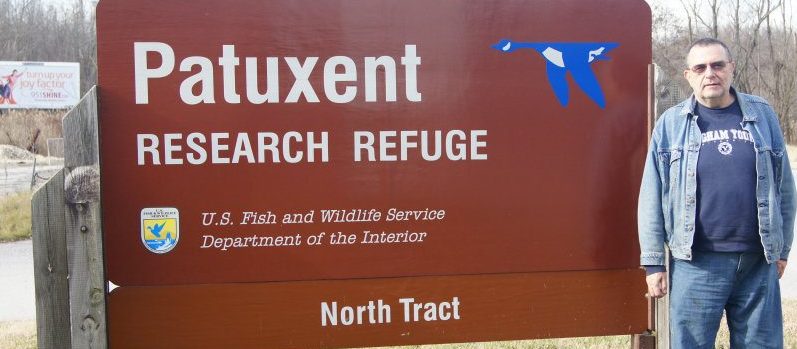
The Patuxent Research Refuge is home to the USGS’s (United States Geological Survey’s) Patuxent Wildlife Research Center. One of the on-going projects conducted by the USGS there is the Whooping Crane Captive Breeding Program. This actual area where the program is being conducted is not open to the general public. However, the Whooping Crane Observatory is open to visitors by permission and only on special occasions. The cranes involved with the breeding program are kept away from human contact, even from the many of the staff because they are very sensitive to human disturbance. It is my understanding that the two cranes on display and pictured here have been habituated to humans.
Since I only had my macro lens with me, I could not get a clear shot of the cranes. A good telephoto lens would have made the job easier. Maybe another time.
Several individuals of this beautiful butterfly, called the Great Spangled Fritillary, were flying around the North Tract Contact Station this afternoon. They were feeding on the nectar of the Common Milkweed growing in the flower beds around the building.
Its scientific name is Speyeria cybele. It ranges from Southern Canada and Northern California on the west to the Atlantic Coast on the east. It prefers woodland edges and moist meadows. Its larval host plant includes various species of Violets (Viola), which are common on the refuge. There are several accepted sub-species of Great Spangled Fritillary. I am not sure which one this is.
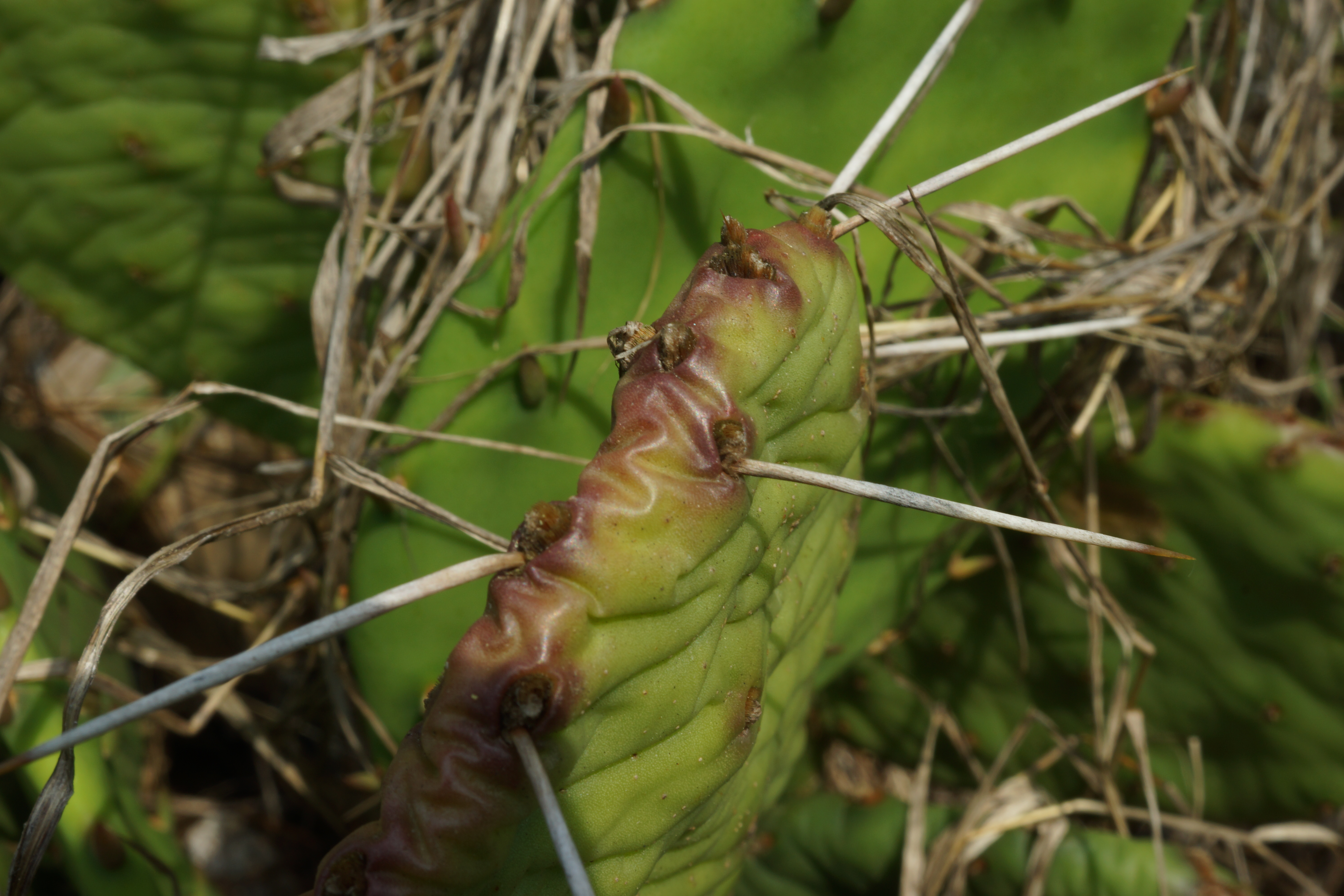
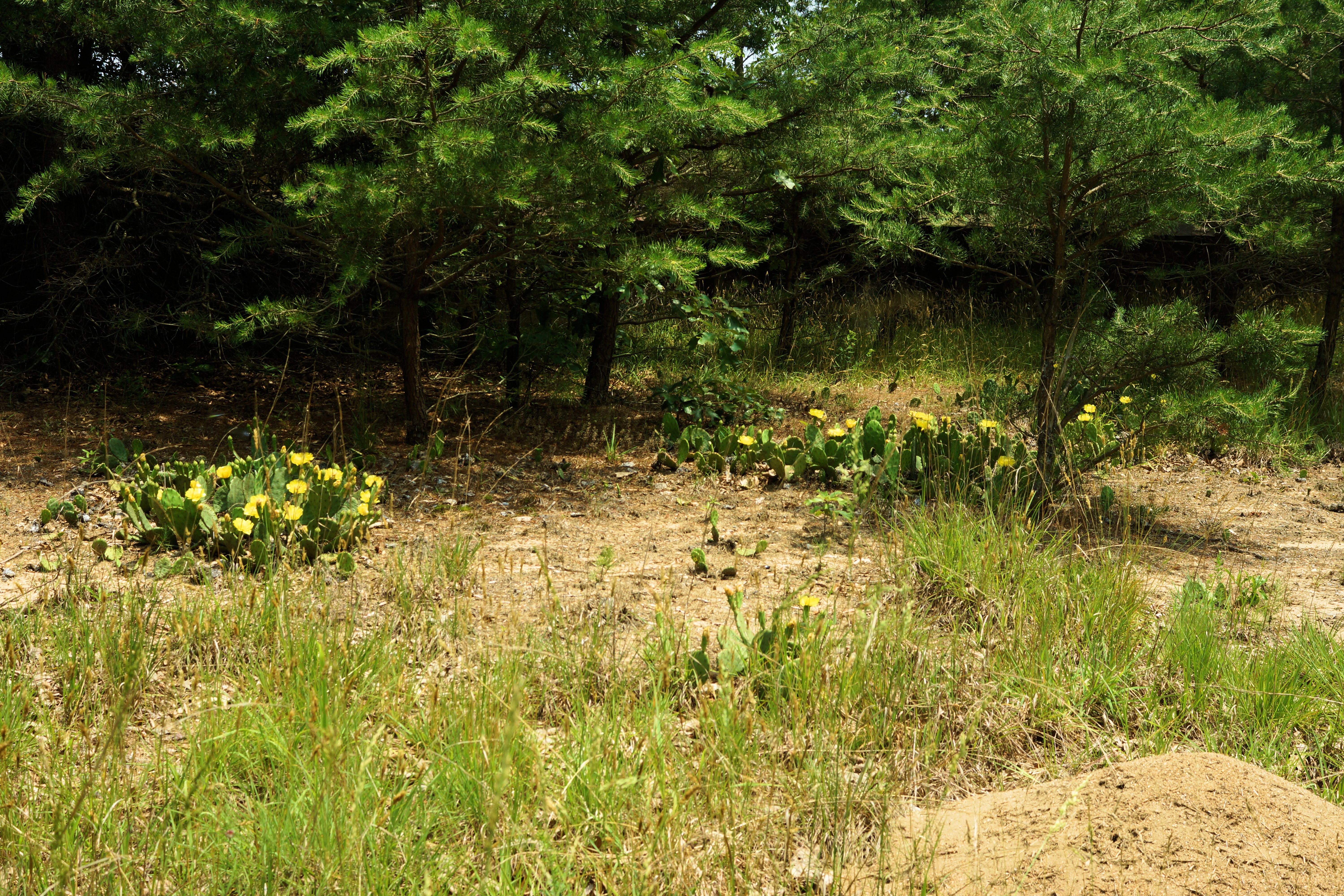
This afternoon, I took a quick jaunt out to Lake Allen to take some pictures of the Eastern Prickly Pear, a type of cactus that is found on the Refuge. Its scientific name is Opuntia cespitosa Raf. Its natural range is primarily west of the Appalachians and east of the Mississippi. However, there are scattered populations of this species along the Atlantic Seaboard from New England to Georgia.
The population on the refuge is rather large, covering several acres. It could be one of the largest populations of cactus in Maryland. On the refuge, it thrives in the sandy soils of the northeastern part of the North Tract by Lake Allen and by the firing ranges.
Allegheny Mound Ant mound in the upper left hand corner
It is shade intolerant and thrives in full sun, and needs well-drained soil.
The fruit of the Opuntia cespitosa is edible, and can stay on the plant until the next spring. Here on the refuge, it blooms from late May to mid-June.
In a couple of the shots I had to deal with the pesky Allegheny Mound Ants (Formica exsectoides). Without looking, I plopped down on a swarm of them, and within a minute or so they were crawling all over me. I even had to take one off of my forehead. They are an interesting critter and merit a separate blog entry. You can see a couple of their mounds in the pictures on this page. (More about them in future blog entry)
While I was driving on Wildlife Loop on the North Tract today, I saw a small black object in the road. At first, I thought it was a piece of debris, but on closer examination it was a Spotted Turtle (Clemmys guttata). I drove around the turtle and got out of my Jeep to take these pictures.
Spotted turtles are found in North America from Ontario and the Great Lakes region in the USA and in Atlantic Coastal States, mostly east of the Appalachians. This one is a male. Male Spotted Turtles have a tan chin, brown eyes, and a long, thick tail. The females’ chin is orange; she also has orange eyes and a shorter tail than the male. Also male Spotted Turtles‘ bottom shell is concave, while the females’ are flat or convex. The eyes on this guy look orangish probably due to the flash I used. However, he was definitely a male because his bottom shell was concave and because his chin is light colored.
The Spotted Turtle prefers wetland habitats, such as swamps, bogs, fens, marshes, woodland streams, and wet pastures. That is why it was interesting seeing him trying to cross the road. The wet weather we have had this spring could explain this.
The Spotted Turtle is federally endangered in Canada, but not yet listed as endangered in the USA under the Federal Endangered Species Act. However, the International Union for Conservation of Nature (IUCN) lists this species as vulnerable to extinction. It is listed as endangered in Indiana.
I don’t know which species of Harvestman this is. It stood still long enough for me to take a couple of good shots. Some people mistakenly believe that Harvestmen are spiders, but they are not. They belong to the Opiliones order of arachnids. This order consists of over 6,500 known species. They are sometimes called Daddy Long Legs, among other names.
I posted these pictures on bugguide.net with the hope someone can determine which species this is. If not, these are some good pictures of an interesting critter. If you look closely, you can see its eyes on the top towards the front.
I found this little guy, called a Thistle Tortoise Beetle, crawling on some musk thistle that I found on the refuge. Its scientific name is Cassida rubiginosa and it is native to Eurasia. From what I understand, this beetle was introduced to Quebec in 1901 as a control for thistles.
The Thistle Tortoise Beetle has spread throughout North America as far west as Colorado and Alberta and to the East along the Atlantic Coast. It was introduced into New Zealand in 2006. It is sometimes called the Green Tortoise Beetle.
This morning a common snapping turtle was trying to cross the road in front of our house. I believe this was a female in search of a nesting site, and could be the same one we saw on our driveway several years. She was first spotted by my wife Becky and after she alerted me, I went out to see what was going on. I managed to take a few photos and then I moved her off the road so she would not get hit. To avoid getting bit and getting clawed by their legs, it is best to grab them in a place where they cannot reach, like by the carapace (upper shell) above their hind legs. She did not like my picking her up at all. But I safely moved her out of harm’s way without incident.
The common snapping turtle‘s scientific name is Chelydra serpentina L. They are native to much of the USA except the extreme Far West. They are also found in the southern part of Canada as far west as Alberta. They are omnivores and will scavenge for animal and plant matter; they are also active hunters and will eat any animal they can fit in their mouths. Their life span is not well known, but is assumed to be at least 100 years.
They have a ferocious disposition and as a result make poor pets. Their name suggests that they have a strong bite. While it is true one would not want to get bit by one, their strength of their bite is comparable to a human.
They have become invasive in some parts of Europe probably because of people releasing them after trying to keep them as pets.
Today, while looking at a Black Oak (Quercus velutina) specimen, I spotted a green fuzzy object moving around on a leaf. It was a Crown Slug Caterpillar (Isa textula) It is a fairly common moth in Eastern North America and its larva can be found on Cherry, Maple, Oak, Basswood, and Elm species. In the adult stage, this creature is a nondescript brown moth.
This rather industrious Yellow and Black Garden Spider (Argiope aurantia) built one of the most unusual webs I have ever seen. She took the pappus from nearby Yellow Salsify (Tragopogon lamottei Rouy) seed heads and embedded it in her web. By the looks of things, she has done rather well because she is rather plump. I found her and her web beside the road across from Big Meadows on Skyline Drive, Shenandoah National Park, Virginia.
Bill
View of full webGoat’s Beard pappus embedded into spider web
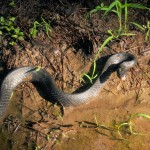
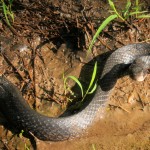
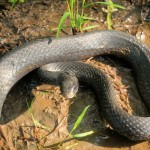
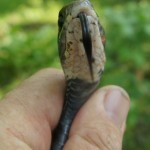
Watch it buster!Today while slogging in the steam which flows between Beaver Valley and Shangri La I had a close encounter with a snake called a Black Racer – (Coluber constrictor). It did not try to slither away like most racers I have seen before. Instead it coiled up and tried to look threatening. I spotted it next to the stream in a patch of sun that was poking its way through the tree canopy. I assume it was trying to get some sun, but because it was next to the stream it was still cold and sluggish. Anyway, the closer I got the more it coiled up and when I was on top of it its tail was shaking rapidly. In order to see what its underside looked like I carefully pick it up and took a quick photograph and let it go.
(Click on thumbnails below for larger view.)
Trying to catch some rays
Get out of here human!
Imean it!
Watch it buster!
White on the underside of head and rest of underside is black
While traipsing through the woods near Wild Turkey Way at Loblolly Fork I stepped on a log which broke and exposed a bunch of little critters scurrying about. I examined the log closely and discovered that the critters were termites. They were hard to photograph because they did not stay still. But I managed to get a few halfway decent images of them.
While driving down Telegraph Road, I saw some movement in a mud puddle in front of me. I slowed down and discovered a bunch of American Toad (Bufo americanus) swimming around. Looking a little closer, I discovered that they were mating. I also spotted some egg strands.
Today I did not do much botanizing. Instead I just drove around to see what I could find. Along side South Road near the BGE Powerline Right-of-way I spotted a lizard, which I believe is an Eastern Fence Lizard.
In the cleared area near the Old Village Corner, I spotted a cool looking spider walking across some exposed sandy soil. It is a Northern Black Widow Spider (Latrodectus variolus), possibly a male.